
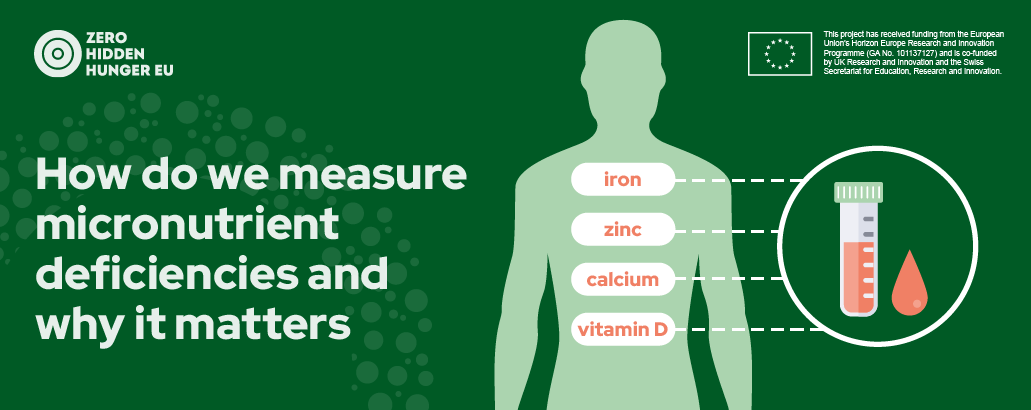
Vitamins and minerals, together called micronutrients, are essential for our bodies to work properly. They play key roles in metabolism and are essential to maintaining health. When the diet lacks of vitamins and minerals people can experience hidden hunger, which can lead to deficiency-related health problems, particularly during pregnancy or for people with certain health conditions.
To provide updated micronutrient recommendations across Europe, researchers need a clear picture of the micronutrient status of individuals and populations. This requires reliable biomarkers—measurable indicators in the body that reflect micronutrient levels. Biomarkers are usually measured from body fluids (like blood or urine) and interpreted in relation to the quality of the diet, particularly its micronutrient density. While some biomarkers are well-established, there are still scientific challenges when it comes to measuring accurately.
Yet, assessing nutritional health through these measurements is essential for developing dietary recommendations and monitoring their efficacy at both population and individual levels.
How micronutrient status is measured
Micronutrient levels can be measured using different sample types. Among the most common there are blood and urine.
Blood samples are commonly used, either to measure levels of the micronutrient itself or the forms in which it is stored or transported. These biomarkers can tell us whether enough of the micronutrient is available to meet the body’s needs. In some cases, however, interpretation of biomarker levels needs to be adjusted for physiological conditions, like inflammation. For example, plasma ferritin reflects iron storage under normal conditions, but it increases during inflammation. Because of this, ferritin levels may need to be adjusted based on levels of C-reactive protein (CRP), a marker of inflammation.
Urine samples are also useful. For instance, they can be used to assess iodine status.
Factors affecting nutrients status
The challenge in using biomarkers is that they do not always reflect how well a nutrient is functioning in the body. Many factors, both intrinsic and extrinsic, can influence how nutrients are absorbed, processed, and used. This means that nutritional needs differ from person to person.
The following factors may confound the interpretation of the results of micronutrient assessment.
- Extrinsic factors: fasting, diet, hydration, use of oral contraceptives or hormone therapy, medications, stress, environment, season, lifestyle, alcohol, smoking, and physical activity.
- Intrinsic factors: inflammation, age, sex, body weight, pregnancy, hormonal changes, genetics, and interactions between nutrients (e.g., vitamin C enhances iron absorption).
For some micronutrients, biomarkers alone may not capture deficiency prevalence. Calcium is a good example of this challenge. Levels of ionized calcium in the blood are tightly regulated by a complex mechanism, limiting this biomarker’s usefulness in quantifying calcium status. For this reason, the prevalence of deficiency is unknown in most countries.
When no good biomarker exists for a micronutrient, researchers may use food intake data to estimate the prevalence of inadequate intakes. In addition, metabolomics, which measures a broad range of metabolites in the body, can help identify biological changes linked to low micronutrient intake and may lead to discovering new micronutrients biomarkers.
Why measuring matters for everyone
Researchers from the Zero Hidden Hunger EU project are working to to measure the prevalence of micronutrient deficiencies using biomarkers that have received scientific consensus. In addition, they are using advanced methods, to identify a new metabolite-based biomarker that reflects calcium intake and status.
They are also testing capillary blood sampling technique (a small finger-prick blood sample) to measure specific micronutrient biomarkers compared to conventional blood testing. If this assessment is successful, the project will provide evidence for the usability of a capillary blood self-sampling technique, a more practical way to collect micronutrient status data to complement classical venipuncture-based epidemiology approaches that can be logistically complex to implement and maintain.
Overall, Zero Hidden Hunger Europe scientists have an unprecedented opportunity to produce data to help raise awareness, provide strong scientific evidence, and develop targeted strategies to address micronutrient deficiencies across different life stages and populations. Through its efforts, the project hopes to enable public authorities to develop efficient preventative micronutrient deficiency actions and potentially new policies for EU.

Author: Serge Rezzi, PhD
Serge Rezzi’s is a trained scientist in biology and biochemistry with a PhD in organic and analytical chemistry applied to natural products. Throughout his career, his subsequent roles at Nestlé Research (Lausanne, Switzerland) have positioned him as a pioneering figure in molecular nutrition influencing both scientific research and practical applications in nutrition for the general population and patient groups (medical nutrition). Since 2018, Serge leads the Swiss Nutrition and Health foundation (SNHf), a public utility foundation (previously named Swiss Vitamin Institute) developing research programs on nutritional epidemiology (micronutrient deficiencies), nutrition status biomarkers and sustainable nutrition. Serge has co-authored over 110 peer reviewed scientific publications (h-index 58) and 26 patents. He is member of several national and international expert networks in nutrition including the special interest group on micronutrients of the European Society for Clinical Nutrition and Metabolism (ESPEN). Serge is also actively involved in various teaching programs in Switzerland (EPFL, University of Geneva, University of Fribourg, University of Applied Sciences Western Switzerland) on nutrition, nutritional metabolomics and natural bioactives.

Author: Laís Bhering Martins, PhD
Dr. Laís Bhering Martins is a dietitian and nutrition scientist at the Swiss Nutrition and Health Foundation whose current research focuses on micronutrient deficiencies, environmentally sustainable dietary patterns, and nutritional psychiatry. Throughout her career, she has worked in multidisciplinary research centers across Brazil, France, the United States, and Switzerland, contributing to both clinical and preclinical studies linking nutritional factors to metabolic and mental health outcomes.

Author: Priscila Giacomo Fassini, PhD
Dr. Priscila Giacomo Fassini is a dietitian and nutrition scientist at the Swiss Nutrition and Health Foundation with over 20 years of experience in clinical nutrition, university teaching and academic research across Brazil, the USA, and Switzerland. She has contributed to multi-country studies with research experience at Tufts University and Harvard Medical School, where she led clinical trials on metabolism, obesity, and appetite regulation. Her work has been published in peer-reviewed journals, including BMJ Open and the American Journal of Clinical Nutrition.